
The typical landing page converts 6.6% of its visitors: out of every hundred people who arrive, around seven leave their details or buy. That’s the median Unbounce calculated after analysing more than 41,000 pages and 57 million conversions. It might not sound like much, but in our experience sending that same traffic to a homepage performs considerably worse. The difference is that a landing page does one thing, and does it well.
If you’re thinking about launching ad campaigns, introducing a new service or capturing leads for a specific offer, someone has probably told you that you need a landing page. Here we explain exactly what one is, how it differs from your website, when it’s worth having and what it needs to include to work.
What a landing page is (and what it isn’t)
A landing page is a web page designed to get visitors to take one single action: request a quote, book an appointment, download a guide, sign up for an event or buy a specific product. Everything on it, from the headline to the photos, pushes towards that action, and nothing distracts from it.
People don’t usually reach a landing page by browsing your website, but from somewhere else: a Google ad, a sponsored Instagram post, an email or a QR code on a leaflet. That’s why its message has to pick up exactly where the ad or email left off. If the ad talks about “dental implants with finance options” and the page talks about the clinic in general, people feel they’ve landed in the wrong place and leave.
What a landing page isn’t: your website’s homepage, a services page covering five different services or a page that links to the entire menu. Those pages have their job, which is to introduce your business, but when the goal is to get someone to do one specific thing, all those options work against you.
| Landing page | Business website | |
|---|---|---|
| Goal | A single action: enquiry, booking, download or purchase | Introduce the business, its services and how it works |
| Navigation | No menu, or as little as possible, to avoid distractions | Full menu with every section |
| Where visitors come from | Ads, emails, social media, QR codes | Google, searches for your brand, recommendations |
| Message | One, tied to a specific offer or audience | Several, one per service |
| How it’s measured | Percentage of visitors who take the action | Visits, total enquiries, Google rankings |
| Lifespan | Can be temporary, for as long as the campaign runs | Permanent, updated over time |
What a landing page is for
A landing page really earns its keep when you’re already paying or working to attract someone and don’t want to lose them at the last step. These are the uses where we see the biggest difference:
- Google Ads campaigns. Someone who searches for “kitchen renovations in Bromley” and clicks your ad should land on a page about kitchen renovations in Bromley, not on your homepage. Google also takes landing page quality into account when working out your ad’s position, and its own help pages say that higher-quality ads can often lead to lower costs per click.
- Meta Ads campaigns. On Instagram and Facebook, people weren’t looking for anything: the page has to explain within seconds why it’s relevant to them.
- Capturing leads with something of value. A guide, a template, a free assessment or a sample in exchange for an email address.
- Launching a new service or product. To test whether there’s demand before reworking your whole website.
- Events, courses and webinars. Date, programme, places available and a sign-up button. Nothing more.
- Time-limited offers. Seasonal promotions that don’t belong alongside the rest of your website.
Pay attention to the channel, because it changes a lot about what you can expect. In the same Unbounce study, landing pages that people reach from an email convert at almost three times the overall median, because those people already know you. Someone arriving from a social media ad, on the other hand, needs more convincing.
Launching a campaign and need a page that converts?Find out in a minute how much your landing page or new website would cost.
Landing page or website: which do you need?
It’s the most common question, and the short answer is that they don’t compete: one doesn’t replace the other. Your website is your permanent shop window and the thing that works to get you found on Google over time. A landing page is a tool for a specific campaign or goal. Plenty of businesses that sell well have a business website and, on top of that, several landing pages, one for each campaign or service they promote.
Even so, the order matters. This table sums up what we usually recommend depending on your situation:
| Your situation | What makes sense |
|---|---|
| You’re starting from scratch and want to be found on Google | A business website with a page for each service |
| You already have a website and are about to invest in Google Ads or Meta Ads | A landing page for each campaign or service you advertise |
| You sell one very specific service or a one-off offer | A well-built landing page may be enough to start with |
| Your website gets visitors from ads but hardly anyone gets in touch | Check which page you’re sending the traffic to before increasing your budget |
| You want to test whether a new service has demand | A landing page and a small campaign before touching your website |
The mistake that costs the most money
Sending ad traffic to your homepage. You pay for every click and, when people arrive, they have to hunt for whatever the ad promised among menus, services and news. If you’re already running campaigns, a landing page is usually the improvement with the best return, even before increasing your budget. We explain it with numbers in how much to spend on Google Ads.
A note on SEO: campaign landing pages aren’t designed to rank on Google, because they tend to have little text and are sometimes temporary. Many are even set so that Google doesn’t index them, so they don’t compete with the service pages on your website. If what you want is to show up in search results over the long term, that’s a different job: SEO.
What a landing page that converts looks like
Most of the landing pages we review don’t fail because of the design, but because of the message and small obstacles that make people put it off until later. These are the elements that are always there on the ones that work:
- A headline that repeats the ad’s promise. Using the same words people searched for or read. It has to confirm in a second that they’re in the right place.
- A single call to action. One button, one goal. It can appear several times down the page, but always for the same thing.
- A short form. Name, email and only what’s essential. Every extra field is a reason not to fill it in.
- Trust signals near the button. Genuine reviews, results, years of experience, client logos if you’re allowed to use them.
- Answers to questions before they come up. A guide price or starting price, timescales, what’s included and what happens after the form is sent.
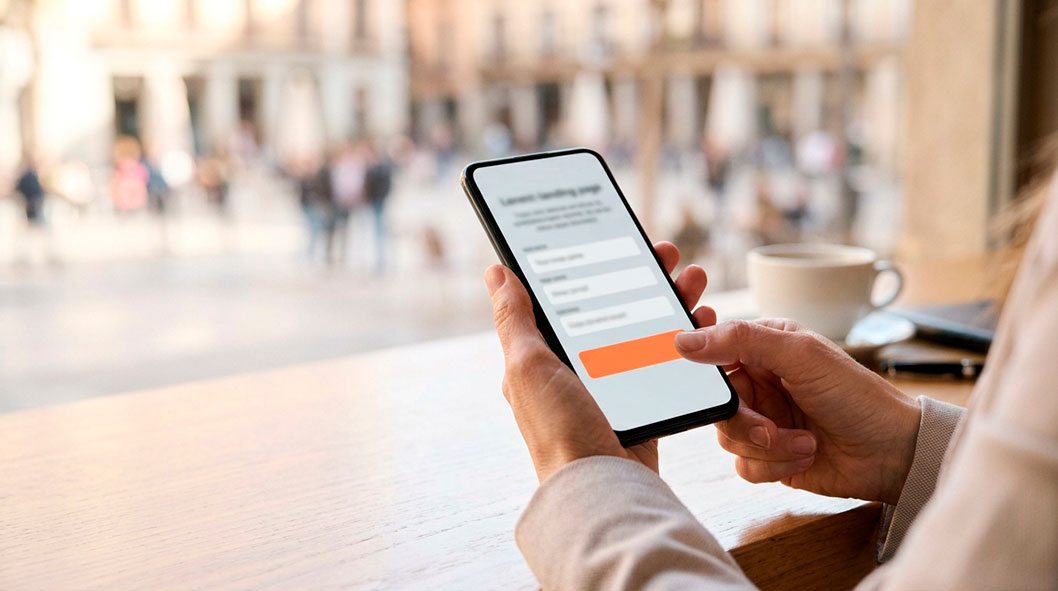
- Designed for mobile first. According to Unbounce, 83% of landing page visits come from phones. The button has to be visible without scrolling and the form must be easy to fill in with your thumb.
- Fast. If it’s slow to load, people go back to the next ad before they’ve even read your headline.
The copy deserves a special mention. Unbounce compared conversion rates by reading difficulty, and the result is clear: pages written in plain language, with short sentences and everyday words, convert 56% better than those written in a more technical tone. The more long words and the longer the reading time, the worse the page performs. It’s not about writing less, it’s about writing clearly.
And these are the mistakes we see most often, which sink conversions however good the design looks:
- A full menu and links to the whole website. Every link is an exit towards something that isn’t your goal.
- Several goals at once. Asking for a quote, a newsletter sign-up and a social media follow on the same page.
- Generic headlines. “Tailored solutions” or “Quality and commitment” mean nothing to someone who’s just clicked.
- A form that asks for everything. Company, job title, budget, how did you hear about us… before offering anything in return.
- Not measuring what happens. Without knowing how many visitors submit the form, there’s no way of knowing what to improve.
How to build your first landing page, step by step
You don’t need to start with anything complicated. A good campaign landing page can be ready in a few days if the plan is clear from the start. This is the order we follow:
- Define one single action. What should people do once they’ve finished reading: request a quote, book or download? If you’re torn between two, make two pages.
- Write for a specific audience and offer. One landing page for “kitchen renovations” and another for “bathroom renovations”, not one for “renovations”.
- Borrow the language of your ad and your customers. The words they use when they search and the questions they ask you by email are your best script.
- Design for mobile first. Headline, benefit, visible button and a short form on the first screen of a phone.
- Track conversions from day one. Set up tracking in Google Ads, Meta Ads and your analytics so you know which campaign brings in leads and which just brings in visits.
- Test and improve. Change one thing at a time, especially the headline and the form, and compare the results once you have enough traffic.
The landing page and the campaign work as a team: a good ad that leads to a weak page wastes your money, and an excellent page with no traffic is no use at all. That’s why, when we run Google Ads and Meta Ads campaigns, we build the landing page alongside the ads. Campaign management starts at €200 a month plus €200 for set-up, excluding VAT, with ad spend of up to €1,000.
What you can do today
Open your latest ad on your phone and click it as if you were a customer. Check three things: whether the page headline repeats what the ad promised, whether you can see the button without scrolling and whether you could submit the form in under a minute. If the answer to any of them is “no”, you know where to start.
If you need a landing page for your campaigns or a website that turns visitors into enquiries, we can help. Take a look at our professional web design service or tell us what you want to achieve.